Construction Material Price Comparison: How to Stop Paying Three Rates for the Same Cement
Ask any purchase team how they control material cost and you will hear the same answer. We take three quotes.
It sounds like a system. It usually is not.
Three quotes tells you which of three vendors was cheapest, for one material, on one day, for one site. It does not tell you whether that rate was good. It does not tell you what your other sites paid for the same material the same week. And it does not tell you what the material actually cost you by the time it reached the work front.
Material is normally the largest single cost on a construction project. A small percentage lost quietly across every purchase, every month, across every site, adds up to a number that would get attention if anyone ever put it on one page. Almost nobody does.
This guide covers what proper price comparison looks like, the cost that the quoted rate hides, and a simple way to start tracking it this week.
Three Quotes Is Not Price Comparison
Here is the situation that costs most companies money, and it does not involve a single bad decision.
Site A buys cement in the first week of the month. Three quotes taken, lowest accepted, approved by the project manager. Reasonable.
Site B buys the same cement in the second week. Different purchase team, different vendor list, different quantity. Three quotes taken, lowest accepted, approved. Also reasonable.
Site C buys in the third week. Same thing again.
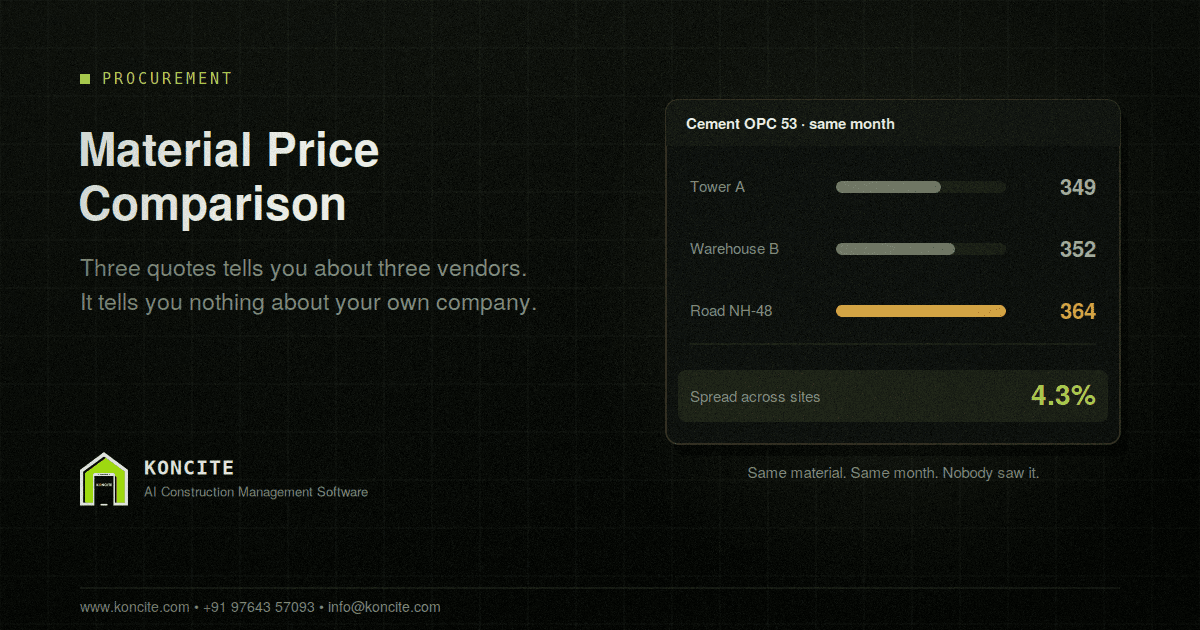
Every purchase was handled properly. Every one was approved by someone sensible. And the company may well have paid three different rates for identical material inside thirty days, with a gap between the highest and the lowest that nobody ever saw, because the three purchases never appeared next to each other.
That is the point most teams miss. The useful question is not “was this quote competitive”. It is “is this the best rate my company has paid this month”. You cannot answer the second question by taking more quotes. You can only answer it by keeping a record.
The Quoted Rate Is Not the Price You Pay
The second problem is that the number on the quotation is not the cost of the material.
The real figure is landed cost, which is what the material costs you by the time it is lying at site and ready to use. Several things sit between the two.
Landed cost per unit = Basic rate + Freight + Loading and unloading + Expected wastage + Cost of credit + GST where you cannot claim input credit
Taking those one at a time.
Freight. A vendor forty kilometres away at a lower basic rate can easily end up costlier than one nearby. For heavy, low value material like aggregate, sand and bricks, freight is often a large share of the delivered cost.
Loading and unloading. Some vendors deliver to the stacking point. Some drop at the gate and your labour carries it. That is a real cost and it belongs in the comparison.
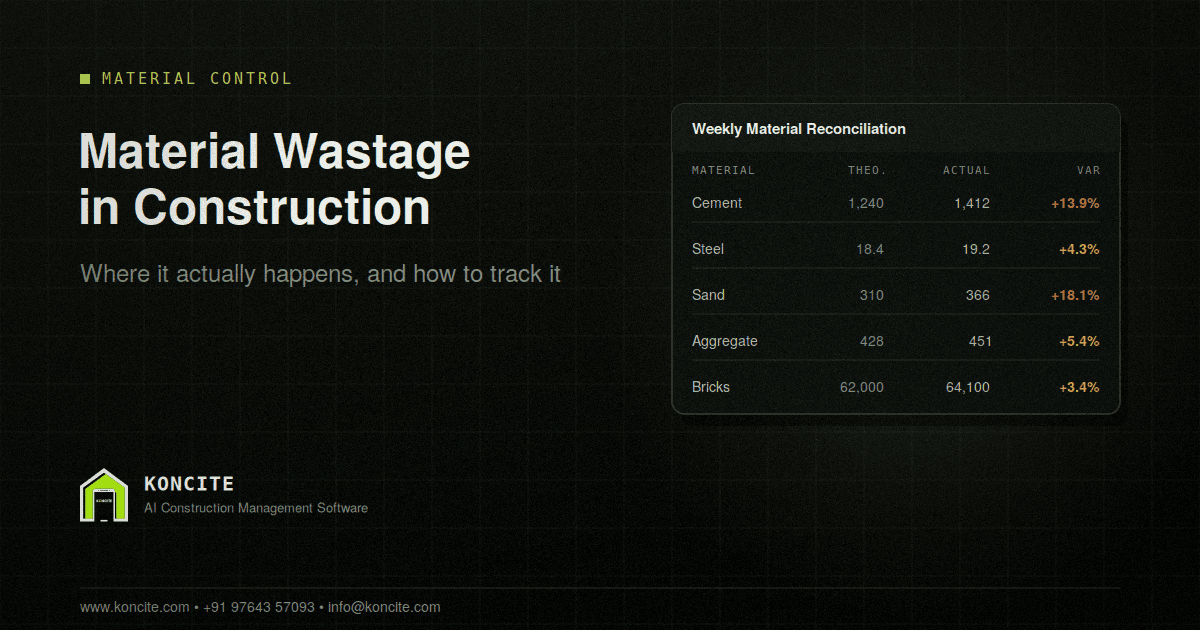
Expected wastage. This is the one most often left out. Bricks and blocks break in transit. Tiles crack. Bags tear. If one vendor’s material consistently arrives with more breakage, their cheaper rate is not cheaper. Our post on material wastage on construction sites covers how to measure this properly.
Cost of credit. A vendor offering sixty days is giving you something that a vendor offering fifteen days is not. If two quotes are within a percent or two of each other, payment terms often decide which one is genuinely better for the company.
GST, in some cases. For most registered contractors, GST is creditable and should be left out of the comparison entirely, so always compare basic rates. But projects sold under the lower residential GST rate without input tax credit are different, because there the tax is a real cost that has to sit inside the landed figure. Check which situation each of your projects is in with your finance team before you build the format, because getting this wrong makes every comparison afterwards misleading.
A Worked Example
Illustrative figures only, not market rates.
| Vendor A | Vendor B | |
|---|---|---|
| Basic rate per bag | 352 | 364 |
| Freight per bag | 14 | 4 |
| Unloading per bag | 6 | 0 (delivered to stack) |
| Expected breakage | 1.5% | 0.5% |
| Payment terms | 15 days | 45 days |
| Landed cost per bag | 377 | 370 |
Vendor A quoted the lower rate and lost on landed cost, before you even account for the better credit period. On a single order the difference looks trivial. Across a project it is not.
Where the Money Actually Leaks
Rate variance between your own sites. Covered above, and it is usually the biggest one. It is invisible by design, because each site approves its own purchases and each purchase looks fine on its own.
Emergency buying. When material runs out and work stops, nobody negotiates. Somebody calls whoever can deliver today and accepts whatever rate is offered, plus urgent freight. The premium on a panic purchase is real money, and it is caused by poor stock visibility rather than poor buying. Every emergency purchase in your records is evidence of a planning problem, not a procurement one.
Rate drift with a regular vendor. The first three orders are sharp. The relationship settles. Twelve months later the rate has crept up in small steps that each looked like a market movement, and nobody rechecked against the market because the vendor is trusted and the deliveries are reliable. This is why a periodic rate review matters even for suppliers you are happy with.
Specification creep. The rate was agreed for one specification and something slightly different is being supplied. Lower grade steel, a different cement type, a thinner section. Comparing rates across different specifications is not comparison at all, and this is where it usually starts.
A Rate Register You Can Start This Week
You do not need a system to begin. You need one file that nobody else is allowed to keep a copy of.
| Date | Material | Exact specification | Vendor | Site | Qty | Basic rate | Landed rate | Payment terms |
|---|
Four rules make this work.
Write the exact specification. OPC 53 and PPC are not the same material. Fe500 and Fe550D are not the same material. If the specification column is vague, every comparison built on it is wrong.
One line per delivery, not per purchase order. Record what was actually received, against the GRN, so your rate history matches your material history. The same discipline described in our DPR format guide applies here.
Keep it company wide, not site wise. The entire value of this register is that it puts your sites next to each other. The moment each site keeps its own version, you are back where you started.
Review it monthly, with the sites in the room. Fifteen minutes, five materials, highest rate against lowest rate. The conversation it produces is usually more valuable than the file.
Which Materials Are Worth Tracking
Do not try to track four hundred line items. You will stop in a month.
On most projects a small number of materials carry the large majority of material spend. Cement, reinforcement steel, aggregate and sand, ready mix concrete, blocks or bricks, and whichever finishing item dominates your particular project, usually tiles or paint.
Start with five to eight. Get the discipline right on those. Add more only once the habit holds.
Mistakes to Avoid
Comparing rates for different quantities. A rate for two truckloads and a rate for half a truckload are not comparable. Record quantity alongside rate or the register will mislead you.
Treating the cheapest vendor as the best vendor. A supplier who is two percent cheaper and delivers two days late has cost you far more than they saved. Supply reliability belongs in the decision, and the easiest way to keep it there is to note delays against the vendor in the same register.
Negotiating only at the start of a project. Rates agreed at tender stage are usually left untouched for the duration. Markets move. Review the main materials every quarter.
Buying on relationship without checking. Long term vendors are valuable and worth keeping. They should still be checked against the market once or twice a year, and any vendor worth keeping will not mind.
Letting sites buy independently with no central view. This is the structural version of the problem. It is not about trust. One person simply cannot see across sites if the information never leaves them.
Where Software Changes the Picture
Everything above can be done in one spreadsheet, and for a company with one or two sites it works well.
It stops working for the usual reason. The data is being created in several places by several people. Indents are raised at site, approvals happen on phone or email, material arrives against a challan at the gate, and the rate sits on a purchase order in the office. Somebody then has to pull those four things together into one line in a file, for every delivery, across every site, every week. That job survives for about a month.
This is what construction procurement software is actually for. Not generating purchase orders, which is the easy part, but keeping the rate, the specification, the vendor, the site and the received quantity attached to each other automatically, so the comparison exists without anyone assembling it.
Koncite AI handles the material cycle from the site end. Purchase requests are raised at site, approvals move through a digital workflow, inward and issue are recorded against each delivery, and stock stays live. Because the rate paid is captured in the same record as the site, the specification and the quantity received, a cross site rate view is a report rather than a project. The same live stock view also removes most of the emergency purchases described earlier, which is usually where the first saving shows up.
If you are evaluating options, the test is simple. Ask whether the system can show you, in one screen, every rate your company paid for cement last month across every site. If it cannot do that, it is a purchase order tool, not a procurement tool.
Frequently Asked Questions
What is material price comparison in construction? It is the practice of comparing the rates paid for the same material across vendors, sites and time periods, using landed cost rather than the quoted rate, so a company can see whether it is buying consistently and competitively.
How do you compare material prices from different suppliers? Compare the exact same specification and quantity, convert each quote into a landed cost by adding freight, handling, expected wastage and the value of the payment terms, and then compare those figures rather than the basic rates.
What is landed cost in construction procurement? Landed cost is what a material actually costs by the time it is at site and usable. It is the basic rate plus freight, loading and unloading, expected wastage and the cost of credit, plus GST where the project cannot claim input tax credit.
Should you always buy from the cheapest vendor? No. The cheapest landed rate is the right choice only when supply reliability and quality are equal. A vendor who delays delivery or supplies material that fails at site usually costs far more than the difference in rate.
How often should construction material rates be reviewed? Compare rates across sites monthly, and review your main materials against the market every quarter. Rates agreed at the start of a project and never revisited tend to drift upward quietly.
Which materials should a construction company track for price? Start with the five to eight that carry most of your material spend, usually cement, reinforcement steel, aggregate and sand, ready mix concrete, blocks or bricks, and the dominant finishing item on that project. Tracking everything is how the habit dies.
Why do different sites of the same company pay different rates? Because each site buys separately, approves separately and keeps its own records. Every individual purchase looks reasonable. The variance only becomes visible when the purchases are placed side by side, which requires a single company wide record.
In Short
Taking three quotes tells you about three vendors. It tells you nothing about your own company.
Compare landed cost rather than quoted rate, keep one company wide register with the exact specification written down, and once a month put your sites next to each other and look at the spread between the highest and lowest rate you paid.
The first month of doing this is usually uncomfortable. It is also the first time most companies find out what their material is really costing them.