Labour Productivity in Construction: How to Track What Your Team Actually Produced
Most construction sites in India know exactly how many workers turned up this morning. Very few know what those workers produced.
That gap matters more than it sounds. Attendance and productivity feel like the same thing, and they are not. You can have a full gang on site every single day for a month and still fall behind, because turning up and getting work done are two different events.
This guide covers the difference, how to measure productivity properly, where it actually leaks on a site, and how to track it without adding more work for your engineers.
Attendance Is Only Half the Number
Here is a situation most project managers will recognise.
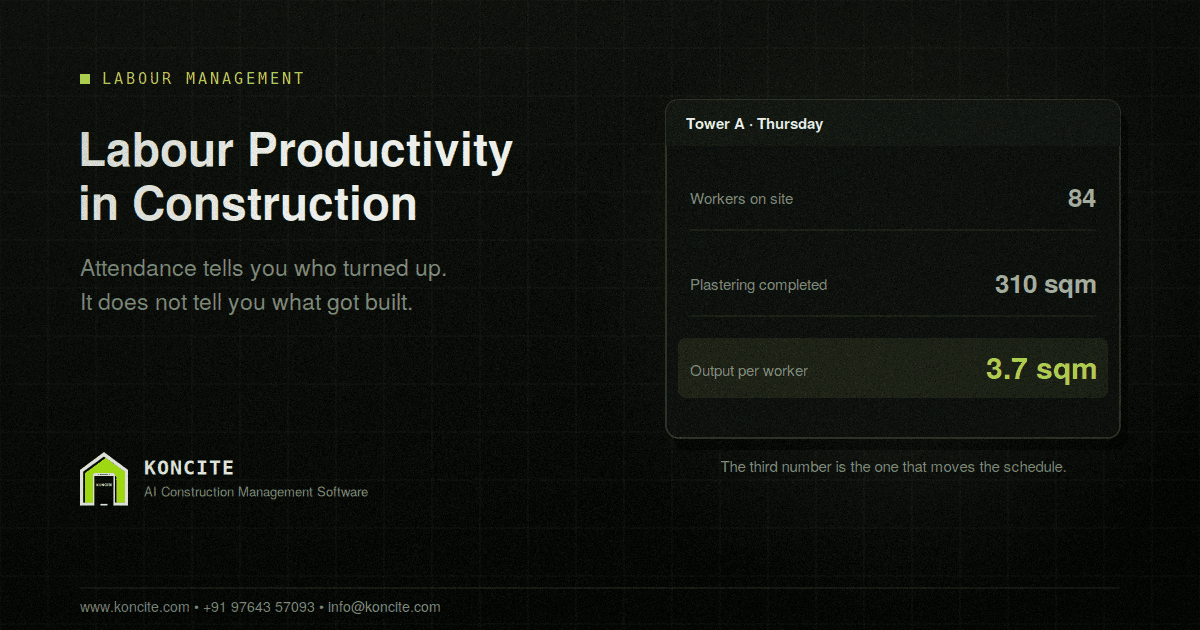
The register says 84 workers were on site. Good number. Better than last week. Everyone signed in, the contractor billed for 84, and the day is recorded as a full day.
Now ask the second question. How much plastering got done with those 84 people?
If you cannot answer that quickly, you are tracking attendance and calling it labour management. Attendance tells you what you paid for. Productivity tells you what you received.
The two numbers only match on a well run site. On most sites they drift apart quietly, and nobody notices until the schedule starts slipping for reasons nobody can explain.
How Productivity Is Actually Measured
The calculation is simple. It is the collecting of the inputs that people find hard.
Productivity = Work completed ÷ Labour used
In practice that means one of two numbers, and both are useful.
Output per man-day. If 10 masons plastered 370 square metres in a day, that is 37 square metres per mason per day.
Man-days per unit. The same figure the other way round. Roughly 0.027 man-days per square metre, or about 2.7 man-days per 100 square metres.
Indian rate analysis already works this way. Schedules of rates and standard rate analysis assign a labour coefficient to each item of work, which is simply an expected number of man-days per unit. So most companies already have a benchmark sitting in their estimate. Very few compare actual site performance against it while the project is still running.
| Activity | Unit | Qty done | Labour used | Output per man-day |
|---|---|---|---|---|
| Plastering | sqm | |||
| Brickwork | cum | |||
| Shuttering | sqm | |||
| Bar bending | MT | |||
| Concreting | cum |
Fill this weekly, per activity, per gang. Within a month you will know your real productivity figures, which is something most construction companies have never seen for their own sites.
Why You Must Measure Per Activity, Not Per Project
A single productivity number for an entire project is close to meaningless.
A project running 40 activities with different gangs, different skills and different work fronts cannot be summarised by one figure. Masonry might be running well while bar bending is far behind, and the average will hide both facts.
Measure by activity. Then by gang where you can. That is the level where you can actually do something about what you find.
Where Productivity Actually Leaks
When productivity is low, the instinct is to assume people are not working hard. On most sites that is the wrong conclusion. Here is where the time usually goes.
Waiting for material. The gang is at the work front and the material is not. Someone goes to the store, the store does not have it, an indent gets raised. Two hours disappear and the attendance register still shows a full day.
Waiting for drawings or approvals. Work cannot start because a detail is unclear or a decision is pending. The workers are present, paid, and idle.
Rework. Any work done twice consumes labour twice. Rework usually gets discussed as a quality issue. It is also one of the largest labour costs on a project and it rarely appears in that column.
Wrong gang composition. Too many helpers and not enough masons, or the reverse. The headcount looks right and the output does not, because the mix is wrong for the work in front of them.
Distance to the work front. Material stored far from where it is used turns productive hours into carrying hours. On tall structures without a working hoist, this gets expensive fast.
No clear target for the day. If nobody told the gang what finished looks like by evening, the work expands to fill the day. A stated daily target changes output more than almost any other intervention, and it costs nothing.
Tools and equipment. Waiting for the mixer, waiting for the hoist, sharing one vibrator across three pours.
Notice that almost every item on this list is a planning or coordination problem, not an effort problem. That is the useful finding. Productivity is usually fixed by management, not by pressure on the workforce.
Tracking It Without Adding Work
This is where most attempts fail. Somebody decides to start measuring productivity, creates a new format, asks site engineers to fill it, and it survives about three weeks.
The important realisation is that you are probably already capturing both halves of the calculation.
If your daily progress report records labour deployed by contractor and category, and it also records work executed with quantities and units, then productivity is not a new thing to measure. It is a division of two numbers you already have.
The problem is that on most sites those two numbers live in different places. Labour sits in an attendance register. Quantities sit in the DPR or in someone’s notebook. Nobody brings them together until month end, by which time the month is over and nothing can be corrected.
Get both into the same daily record and the productivity figure appears on its own.
Five Mistakes to Avoid
Treating it as a performance review. If low productivity gets someone shouted at, the numbers will improve and the output will not. People will report what keeps them out of trouble. Productivity data is a management tool for finding bottlenecks, not a stick.
Comparing across different activities. Shuttering productivity and plastering productivity are not comparable. Compare each activity against its own benchmark or against its own past performance.
Ignoring gang composition. Ten workers is not ten workers. Six masons and four helpers will produce very differently from four masons and six helpers. Record the mix, not just the total.
Measuring monthly. By month end the work is done and the labour is paid. Weekly is the minimum useful interval for anything you intend to act on.
Forgetting the hindrances. If productivity dropped on Tuesday because material arrived at 2 pm, that explanation needs to sit next to the number. A productivity figure without its reason is just a complaint.
Where Software Changes the Picture
Everything above can be done on paper. The reason most companies do not do it is effort, not disagreement.
Collecting attendance from several sites, collecting quantities from several engineers, matching them by activity, and calculating output per man-day every week is a job in itself. It gets done enthusiastically for a month and then quietly stops.
This is what AI construction management software changes. When attendance is captured digitally at site and daily progress is logged with quantities as work happens, the productivity calculation has both inputs already. The number computes itself, trends appear across weeks, and a gang falling behind shows up as an alert rather than as something discovered during a monthly review.
Koncite AI records labour deployment by contractor and category alongside daily progress quantities, from a phone at site. Because both sit in the same daily record, output per man-day is available without anyone assembling it. The point is not to add a productivity report to your team’s workload. It is to make the figure appear from work they are already doing.
Frequently Asked Questions
What is labour productivity in construction? It is the amount of work completed for the labour used, usually expressed as output per man-day, such as square metres of plastering per mason per day, or as man-days required per unit of work.
How do you calculate labour productivity on a construction site? Divide the quantity of work completed by the number of man-days used on that activity in the same period. Measure it per activity rather than for the project as a whole, or the result will not tell you anything you can act on.
What is the difference between attendance tracking and productivity tracking? Attendance records who was present and is what you pay against. Productivity records what was produced for that labour. A site can have perfect attendance and poor productivity, which is why attendance alone is not enough to manage a project.
How often should labour productivity be reviewed? Weekly, per activity. A monthly review arrives after the work is finished and the wages are paid, so there is nothing left to correct.
What is a good labour productivity figure? It depends entirely on the activity, the method and the site conditions, so there is no single number worth quoting. The useful comparison is against the labour coefficient already assumed in your own rate analysis, and against your own performance in previous weeks.
Why is labour productivity low on many construction sites? In most cases it is not effort. It is waiting for material, waiting for drawings or approvals, rework, poor gang composition, long distances to the work front, and no clear daily target. Nearly all of these are coordination problems rather than workforce problems.
In Short
Attendance tells you what you paid for. Productivity tells you what you got.
The gap between those two numbers is where most construction schedules quietly slip, and it is invisible to any site that only counts heads at the gate.
You almost certainly already collect both halves of the calculation. Put them in the same place, look at them weekly, by activity, and record the reason alongside the number. The first month will be uncomfortable. It will also be the first time you can see where the days are actually going.