7 Signs Your Construction Site Is Still Running on WhatsApp and Excel
Most construction businesses do not decide to go digital on a fixed date. They just keep going with what works, until one day it stops working.
WhatsApp groups made sense when you had two sites. Excel sheets were fine when one person tracked everything. Paper registers worked because that is how the industry always ran. None of this was a bad decision at the time.
The problem is that these tools do not grow with you. They quietly start costing you time, money and control, and most teams do not notice until a project slips badly enough to hurt.
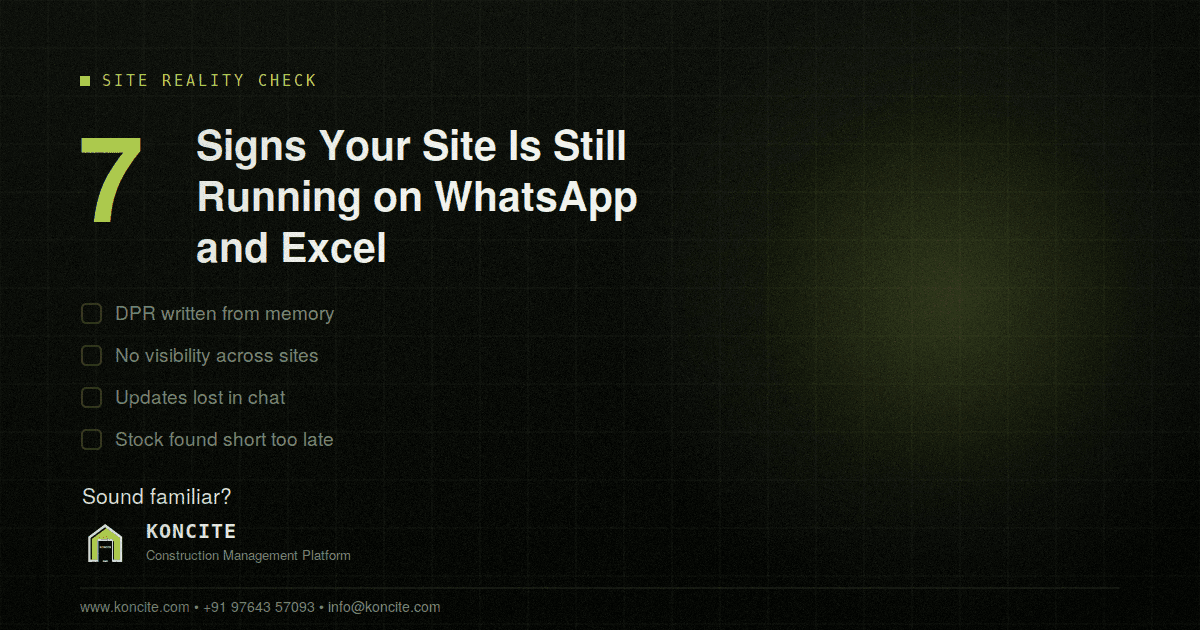
Here are seven signs that your sites have outgrown manual tracking, and that it is time to look at proper construction management software.
1. Your Daily Progress Report Is Written From Memory
Ask yourself when your DPR actually gets filled. If the honest answer is late at night, by someone trying to remember what happened eight hours ago, your reporting is not really reporting. It is recall.
The site engineer was busy supervising work all day. By evening, they are reconstructing the day from memory and a few WhatsApp messages. Small details get missed. Delays get rounded off. Problems that should have been flagged get left out because they did not seem worth mentioning at 10 pm.
Management then reads that report the next morning and makes decisions based on it. So every decision is running one day behind reality, built on an imperfect memory of yesterday.
What good looks like: Progress gets logged from site, as work happens, from a mobile phone. The report builds itself through the day instead of being written from scratch at night.
2. You Manage Multiple Sites But Only Really Know What Is Happening at One or Two
This one is uncomfortable but common. You may have six, eight or twelve active sites. If you are honest, you have detailed visibility into the two or three you visit most often or where your most reliable engineer is posted.
The rest run on trust. They are probably fine. You will find out if they are not, usually when something has already gone wrong and it is too late to fix cheaply.
This is not a people problem. It is a visibility problem. No one can hold detailed status for twelve sites in their head, and no WhatsApp group gives you a clean picture across all of them at once.
What good looks like: One dashboard where every active site shows its current status, today’s progress, pending approvals and flagged delays, without you having to call anyone.
3. Important Updates Get Lost in WhatsApp Groups
WhatsApp is excellent for quick communication. It is a poor system of record.
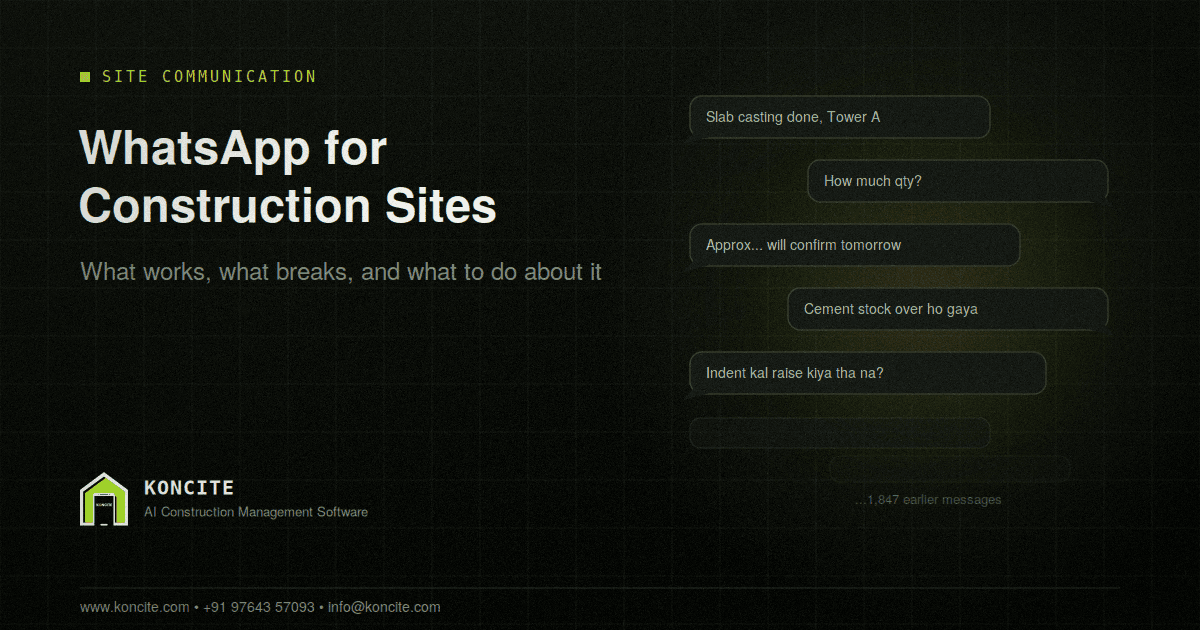
Think about what happens in a busy site group. Someone shares a photo of a problem. Someone else asks a question. Three people reply about something unrelated. A supervisor sends a voice note. By evening, that original problem is forty messages up, and nobody remembers who was supposed to act on it.
Then there is the bigger issue. Six months later, when there is a dispute with a contractor about who approved what and when, you are scrolling through thousands of messages trying to reconstruct a decision. Sometimes the person who sent it has left the company and the group history is on their phone.
What good looks like: Updates, approvals and decisions live in a system where they are searchable, timestamped and tied to a specific project, not buried in a chat thread.
4. You Find Out About Material Shortages When Work Has Already Stopped
Here is a pattern most site teams will recognise. Cement or steel runs out. Work stops. Someone raises an urgent indent. Someone else chases the vendor. Half a day or more is lost, and everyone is now working in emergency mode on something that was completely predictable.
Stock exists on a register somewhere. But the register is at the site office, updated by hand, and nobody was watching the numbers closely enough to see the shortage coming three days ago when there was still time to order calmly.
The reverse problem is just as expensive. Teams over order to feel safe, and material sits on site getting wasted, damaged or quietly disappearing.
What good looks like: Live stock levels visible before you run out, with alerts when material is running low, so ordering happens on schedule instead of in panic.
5. Finding One Detail in a Drawing Takes Half an Hour
A site engineer needs the footing size for a specific column, or the reinforcement detail for a particular beam. In theory this takes two minutes. In practice it often does not.
The drawing is a PDF on someone’s phone. It might be the latest revision, or it might not. The engineer scrolls, zooms, squints at a small screen, and either finds it or calls someone to confirm. Multiply that by several times a day, across several people, and the lost time adds up to something serious.
Worse is when someone works off an outdated drawing because they did not know a revision had come through. That mistake does not cost minutes. It costs rework.
What good looks like: Drawings, BOQs and specifications stored in one place with clear version control, and the ability to pull a specific detail out quickly instead of hunting through pages.
6. Labour Attendance and Contractor Records Are Still on Paper
Attendance is written in a register. Contractor supply is tracked in a separate sheet. Payments are calculated at month end by someone cross checking both, usually under time pressure.
Two things go wrong here. First, disputes. A contractor claims they supplied more workers than your records show, and neither side has anything solid to prove it. Second, you have no real time picture of how many people are on site right now across your projects, which makes planning genuinely difficult.
When someone asks how many workers you have deployed across all sites today, the honest answer is usually that you would have to make a few calls to find out.
What good looks like: Digital attendance captured at site, contractor supply tracked against it, and clear records that make payment calculations straightforward and disputes rare.
7. Every Report for Management Is a Manual Exercise
If your team spends the last two days of every month pulling numbers from different sheets into one presentation, that is a sign.
Somebody exports data from one Excel file, copies it into another, formats it, checks it against WhatsApp messages for anything missing, and builds a report. It is careful work and it takes hours. By the time leadership reads it, the situation on site has already moved on.
The cost here is not just those hours. It is that your most experienced people are spending their time assembling information instead of acting on it.
What good looks like: Reports that generate themselves from data already being captured, so the monthly review is about decisions rather than data collection.
How Many of These Sound Familiar?
If one or two of these ring true, you probably have time. If five or more do, your current setup is already costing you more than you realise, and it is likely getting worse as you take on more projects.
The important thing to understand is that none of these problems are caused by your team working badly. In most cases they are caused by good teams working hard inside a system that was never designed to handle the number of sites they are now running.
What to Look For When You Start Evaluating Options
If you are ready to look at construction management software, here is what actually matters for site heavy businesses:
- Mobile first design. If your site engineers cannot use it easily on a phone, standing on site, it will not get used. This is the single most common reason software fails on construction projects.
- Fast setup. Your sites cannot pause for a six month rollout. Look for something that can be running in days, not months.
- Covers the full site workflow. Progress reporting, labour, materials, documents and approvals should sit in one place. Solving one problem and leaving four unsolved just adds another tool to the pile.
- Simple enough for real adoption. Your team should be productive without weeks of training. If it needs a dedicated IT person to run, it is probably built for a different kind of company.
- Built for how Indian sites actually work. Workflows, contractor structures and reporting expectations here are specific. Software designed elsewhere often does not fit without a lot of adjustment.
The Bottom Line
WhatsApp and Excel are not the enemy. They are just tools that made sense at a smaller scale and quietly stopped being enough as you grew.
The signs above are not really about software. They are about whether you can see what is happening across your projects clearly enough to act in time. When the answer becomes no more often than yes, that is when it makes sense to change how you run your sites.