WhatsApp for Construction Sites: What Works, What Breaks, and What to Do About It
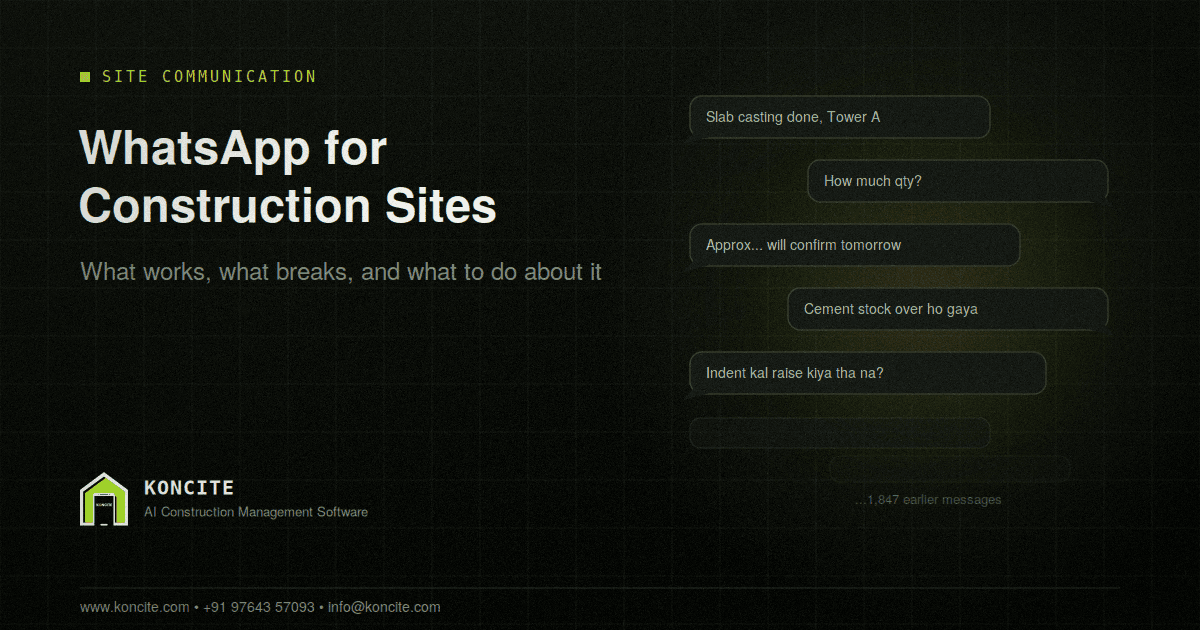
Walk onto almost any construction site in India and ask how the team communicates. The answer is WhatsApp. Not the ERP the company bought three years ago. Not email. WhatsApp.
Most software companies treat this as a problem to be fixed. Tell the team to stop using WhatsApp, move everything into a proper system, and discipline will follow. It almost never works. Six weeks later the site group is busy again and the software sits unused.
The honest view is more useful. WhatsApp became the default for good reasons, it does several things genuinely well, and it also breaks in specific and predictable ways. Understanding both is how you actually fix site communication instead of fighting it.
Why WhatsApp Won on Indian Construction Sites
It is worth being clear about this, because any solution that ignores it will fail.
Everyone already has it. No training, no login problem, no app to install. A new contractor joins on Monday and is in the group by Monday afternoon.
It works on any phone and any network. Site engineers are not sitting at desks. They are walking a slab in the afternoon heat with one bar of signal. WhatsApp is built for exactly that.
It is fast. A photo of a problem reaches the project manager in seconds. No form, no field to fill, no process.
It is the language of the site. Voice notes in Hindi or Marathi. A quick photo instead of a written description. This is how people on site actually communicate, and it is not going to change because head office bought software.
Any team telling you WhatsApp has no place on a construction site has probably never had to get a slab poured on schedule.
Where It Quietly Breaks
The problems do not show up on day one. They show up as you grow.
1. Nothing Is Searchable
Six months later there is a dispute. Was the contractor told to stop work on the fifth floor, and when? Somebody starts scrolling. In an active site group that is thousands of messages, mixed with photos, forwards, and good morning stickers.
Even when you find the message, you have found one message. Not the decision, not the context, not who acted on it.
2. Information Lives on Individual Phones
The site engineer who ran the project for eighteen months leaves. Their phone leaves with them. So does the group history, the photos, and the informal record of everything that happened.
This is the single biggest risk most companies do not think about until it happens.
3. Nothing Becomes Data
A hundred site updates a day flow through WhatsApp. None of them turn into a progress percentage, a labour count, a material consumption figure, or a delay flag.
At month end somebody sits down and manually reconstructs a report from chat history and memory. The information was there all along. It just never became usable.
4. Accountability Disappears
Somebody raises an issue at 11 am. Two people reply about something else. By evening the original message is far up the thread and nobody owns it. There is no status, no assignment, no closure.
Work does not stop because people are careless. It stops because a request had nowhere to live.
5. Approvals Have No Trail
A material indent gets approved with a thumbs up emoji. A drawing revision is confirmed with “ok go ahead”. These are real commercial decisions with no formal record, no timestamp anyone would rely on, and no audit trail.
That is fine until there is a disagreement about money.
6. Management Sees Fragments, Not Status
A director in twelve site groups sees a constant stream of activity but no picture. Which of the twelve sites is behind today? Which has a material shortage coming? WhatsApp cannot answer that, because it was never built to.
7. Photos Get Lost
Site photographs are among the most valuable records a project generates. In WhatsApp they are compressed, undated in any useful sense, spread across groups, and eventually cleared to free up phone storage.
The Real Cost
None of these are dramatic on any given day. That is what makes them easy to miss.
The cost shows up as reports that take days to assemble instead of appearing on their own. As disputes that get settled on relationship rather than record. As delays noticed a week after they started. As a new project manager taking two months to understand a project because there is nothing written down.
The team is working hard the whole time. The system around them is just losing most of what they produce.
The Fix Is Not “Stop Using WhatsApp”
This is where most digitization efforts go wrong.
Telling a site team to abandon the one tool they actually use, and replace it with an app that requires a login, training, and a stable connection, is asking them to work harder so that head office can have better reports. It gets resisted, and it should.
The better approach is to keep WhatsApp as the way people communicate, and connect it to a system that turns those messages into structured records automatically.
In practice that means a site engineer sends a progress update the way they always have, by message, photo, or voice note, and it lands in the right project as a proper entry. Labour counts become attendance records. Photos get attached to the correct activity with a date. A material request becomes an indent with a status and an owner instead of a message that scrolls away.
This is what modern AI construction management software makes possible. The AI does the translation work in the background, reading and structuring what the team sends in natural language, so the site does not have to change how it works for the office to get clean data. Koncite AI is built around exactly this idea, because a system that people avoid using is worse than no system at all.
What to Look For
If you are evaluating options, these are the questions that matter for site adoption:
Does it meet the team where they already are? If adoption depends on your engineers changing their daily habits, expect it to fail regardless of how good the software is.
Do updates become structured data automatically? A tool that just archives your chats has solved the storage problem and none of the others. The value is in turning messages into progress, labour, material, and approval records.
Can management see status without asking? The test is simple. Can a director open one screen and see which sites are behind today, without calling anyone?
Is there a real audit trail? Approvals, instructions, and hindrances need timestamps and owners, not emoji.
Does it work in the languages your team uses? Site communication in India happens in Hindi, Marathi, Tamil, Telugu and more, often mixed with English. Software that only understands formal English will not survive contact with a real site.
Frequently Asked Questions
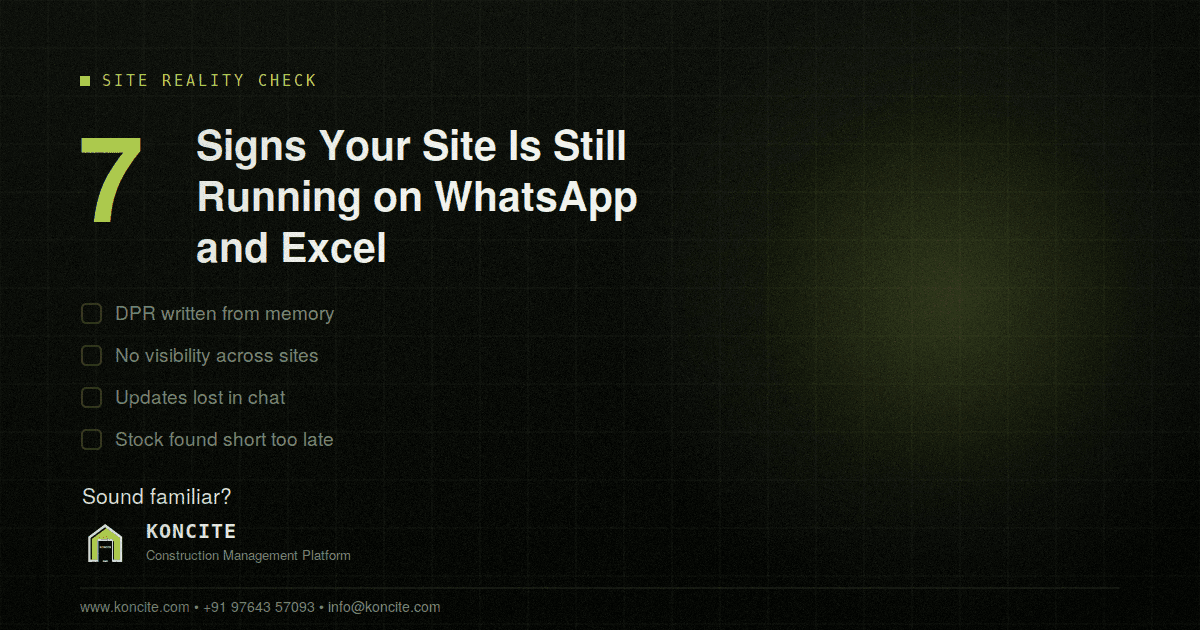
Is WhatsApp good enough for managing construction sites? It is very good for communication and poor as a system of record. It works well on one or two sites. Once you are running several, the lack of searchable history, structured data, and consolidated status starts costing real time and money.
Should we stop using WhatsApp groups on site? Usually no. Removing the tool your team actually uses tends to reduce communication rather than improve records. The better approach is to connect WhatsApp to a system that captures those updates properly.
Can construction software work together with WhatsApp? Yes. AI construction management software can now take updates sent through WhatsApp, including photos and voice notes, and convert them into structured project records without the site team changing how they work.
What is the biggest risk of running a project only on WhatsApp? Losing the record. Project history sits on individual phones, and when someone leaves the company, most of the informal record of the project leaves with them.
How do we start fixing this without disrupting live projects? Start with one site and one workflow, usually daily progress reporting, and keep everything else as it is. Once the site team sees updates turning into reports without extra effort, extending to labour, material and approvals is much easier.
In Short
WhatsApp is not the reason your projects run late. It is doing a job it was never designed for, and doing it surprisingly well considering.
The problem is what happens after the message is sent. Right now, for most construction companies, the answer is nothing. It sits in a thread until it scrolls away.
Fix that part, and you keep everything WhatsApp is good at while getting the visibility, the record, and the reporting your business actually needs.