Understanding Construction ERP vs Management Software
If you’ve started evaluating digital tools for your construction business, you’ve probably run into two terms that get used almost interchangeably: construction ERP and construction management software. Vendors, consultants, and even your own team may use them loosely, but they are not the same thing, and picking the wrong category for your business can mean months of wasted implementation time.
This guide breaks down exactly what separates the two, who each one is actually built for, and how to figure out which one your business needs, whether you’re a builder managing a handful of residential sites or an EPC company running projects across multiple states.
Quick Answer: Construction ERP is a broad, enterprise-wide system that manages finance, HR, procurement, and operations across an entire organization. Construction management software is a focused, site-first tool built specifically to run day-to-day project execution, progress tracking, labour, materials, and documentation. Most builders and contractors need the latter; large EPC and infrastructure companies often need both, integrated together.
What Is Construction ERP?
Construction ERP (Enterprise Resource Planning) is a company-wide software system that connects and manages core business functions, finance and accounting, human resources, payroll, procurement, inventory across multiple business units, and often legal and compliance, under one umbrella.
Construction ERP systems were originally built for large, complex organizations where finance, HR, and operations all need to talk to each other in real time. In construction, this typically means:
- Multi-entity financial consolidation across projects and business units
- Centralized procurement and vendor management at an organizational level
- HR functions like payroll, appraisals, and compliance tracking
- Enterprise-wide reporting for leadership and finance teams
- Integration with taxation, statutory compliance, and audit requirements
Construction ERP is built primarily for the back office,the systems that keep a large organization running, not necessarily the systems that a site engineer or project manager uses every day.
Who Typically Uses Construction ERP
- Large EPC (Engineering, Procurement, Construction) companies with multiple business divisions
- Infrastructure companies managing dozens of concurrent projects
- Organizations where finance, HR, and procurement need centralized, unified control
- Companies with complex compliance, taxation, or multi-entity reporting requirements
What Is Construction Management Software?
Construction management software is purpose-built to manage the day-to-day execution of construction projects, the work that actually happens on site. Instead of trying to run your entire company’s finance and HR through one system, construction management software focuses on solving the operational problems that slow down site teams:
- Daily Progress Reports (DPR) and real-time work tracking
- Labour attendance, contractor records, and workforce management
- Material and inventory tracking, purchase requests, approvals, stock levels
- Document management for drawings, BOQs, contracts, and approvals
- Multi-site dashboards for real-time visibility across projects
- Work orders and site-level billing
This category exists because most builders and contractors don’t need, or can’t realistically implement, a full enterprise ERP just to stop losing daily updates in WhatsApp groups or tracking material stock on paper registers. Construction management software is designed to be adopted quickly by site engineers and project managers, not just finance teams.
Who Typically Uses Construction Management Software
- Builders and residential/commercial contractors managing multiple active sites
- Mid-size construction companies that need operational control without enterprise complexity
- Project managers, site heads, and construction heads who need real-time visibility
- Real estate developers coordinating execution across several projects at once
Construction ERP vs Construction Management Software: Key Differences
| Factor | Construction ERP | Construction Management Software |
|---|---|---|
| Primary Focus | Company-wide finance, HR, and operations | Day-to-day site execution and project tracking |
| Who Uses It Daily | Finance, HR, and back-office teams | Site engineers, project managers, site heads |
| Implementation Complexity | High, often requires dedicated IT support | Low, designed for fast, self-serve adoption |
| Core Strength | Financial consolidation, compliance, procurement at scale | Real-time site visibility, labour, materials, documents |
| Best Suited For | Large EPC and infrastructure organizations | Builders, contractors, and mid-size developers |
| Adoption Timeline | Often months, involving change management | Typically days to a few weeks |
| Mobile / Field Usability | Frequently limited or an add-on | Usually built mobile-first for site teams |
The Core Misconception: “ERP” Doesn’t Automatically Mean “Better”
One of the most common mistakes builders make is assuming that because ERP sounds more comprehensive, it must be the more capable choice. In practice, the opposite is often true for site-level problems.
A traditional ERP is built to manage the business. Construction management software is built to manage the build. If your actual pain points are things like:
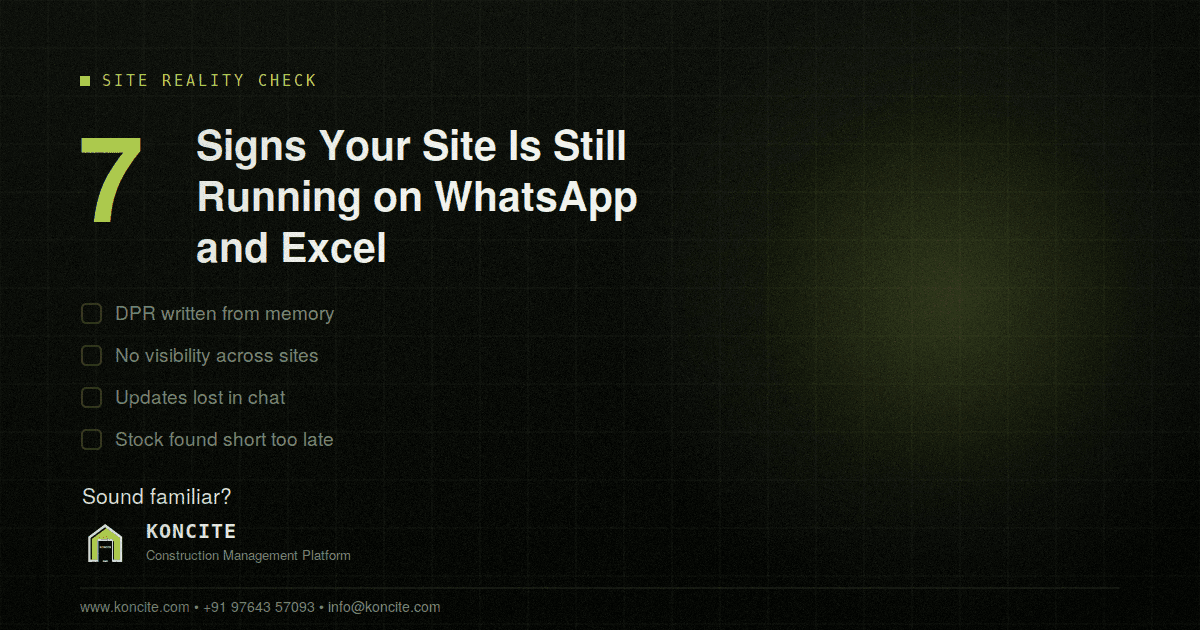
- DPRs compiled late at night from memory instead of real site data
- No visibility into which of your 8 sites is actually on schedule
- Material shortages discovered only when work has already stopped
- Drawings, approvals, and contractor records scattered across phones and paper
…then a heavyweight ERP system won’t necessarily solve these problems faster. These are execution-layer problems, and they’re solved by tools built specifically for site operations, not by a system primarily designed for finance consolidation.
This is also why many construction ERP implementations struggle with adoption on site: they’re built with back-office logic first, and field usability is often an afterthought.
How AI Is Changing This Comparison
A newer factor now separates modern construction management platforms from both traditional ERP systems and older-generation site software: AI-powered document and drawing intelligence.
Historically, neither ERP nor basic construction management tools could actually understand the content of an engineering drawing. If a site engineer needed to know the footing size of a specific column or the reinforcement detail of a beam, the only option was manually flipping through PDF drawings, often on a phone, often mid-conversation with a contractor.
AI-powered construction platforms now allow teams to upload structural or architectural drawings and simply ask questions in plain language, “What is the footing size of Column C4?” – and get an instant, accurate answer pulled directly from the drawing. This is a capability neither traditional ERP systems nor most legacy construction management tools were built to offer, and it’s becoming an important differentiator when evaluating platforms in 2026.
Which One Does Your Business Actually Need?
Ask yourself these questions:
Choose construction management software if:
- Your biggest daily frustrations are on-site: reporting, labour tracking, material visibility, document chaos
- You want your team using the tool within days, not months
- You’re a builder, contractor, or mid-size developer managing multiple active sites
- You don’t have a dedicated IT team to manage a complex enterprise rollout
Consider construction ERP (often alongside a construction management layer) if:
- You’re running a large, multi-entity EPC or infrastructure business
- Your finance, HR, and procurement functions need deep, organization-wide integration
- You have the internal resources to manage a longer, more complex implementation
- Compliance, statutory reporting, and multi-project financial consolidation are core operational needs
For many growing construction businesses, the practical answer isn’t “ERP or construction management software” – it’s starting with strong site-level execution software first, since that’s where the daily operational pain actually lives, and adding deeper financial/ERP integration as the organization scales.
Frequently Asked Questions
Is construction ERP the same as construction management software? No. Construction ERP is a broad, company-wide system covering finance, HR, and procurement. Construction management software is a focused tool for day-to-day site execution, progress tracking, labour, materials, and documents.
Can a construction company use both? Yes. Large EPC and infrastructure companies often use construction ERP for enterprise-wide finance and operations, alongside dedicated construction management software for site-level execution and real-time project tracking.
Which is easier to implement – ERP or construction management software? Construction management software is generally faster and easier to implement, since it’s built for direct use by site teams and doesn’t require the deep organizational integration that ERP systems typically need.
Do small and mid-size builders need construction ERP? Usually not. Most small and mid-size builders and contractors are better served by construction management software, since their core challenges, daily reporting, labour tracking, material visibility, document management, are execution-layer problems, not enterprise finance problems.
What should I look for in construction management software in 2026? Look for real-time multi-site dashboards, mobile-first daily progress reporting, labour and inventory tracking, centralized document management, and, increasingly important , AI capabilities that can answer questions directly from your drawings and project documents.
The Bottom Line
Construction ERP and construction management software solve different problems for different parts of your business. ERP manages the enterprise. Construction management software manages the build. Understanding which category actually addresses your day-to-day pain points, rather than assuming “more comprehensive” means “more useful” – is the first step to choosing the right platform for your team.