Construction Manpower Planning Across Multiple Sites
Ask any construction company how many workers they have on site today and you will get an answer, usually within an hour.
Ask how many they will need in the third week of next month, broken up by trade, across every active site, and the room goes quiet.
That gap is where most multi-site labour problems live. Not in attendance, not in productivity, but in the fact that almost nobody plans manpower forward. Companies react to it. They find out they are short when a gang does not turn up, and they find out they are long when they see forty people standing around with nothing to do.
This guide covers how to plan manpower properly across several sites, including the two things that trip up Indian projects most often and that general project management advice never mentions.
Why Per Site Planning Breaks Down at Three Sites
With one or two sites, the project manager holds the plan in his head and it mostly works. He knows his programme, he knows his contractor, he can see the whole thing.
At three sites and above, four things go wrong at once.
Each site protects its own gang. A project manager who finally has a good team of masons will not volunteer them to another site, even during a slow fortnight. This is rational behaviour from his point of view and expensive from the company’s.
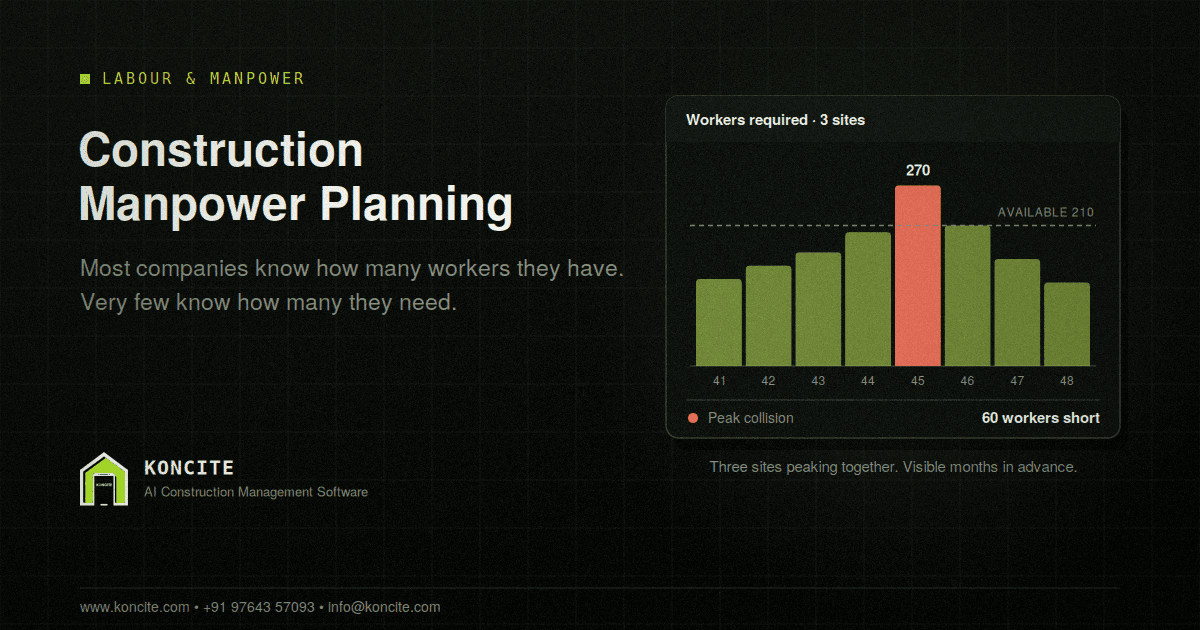
Peaks collide without anyone noticing. Every site’s programme has a labour peak. If three of them land in the same two weeks, you have a crisis that was visible on paper months earlier and that nobody looked for. If they land in sequence, you can move gangs and save a great deal of money. The difference between those two situations is a chart nobody drew.
The labour contractor gets no notice. More on this below, because it is the single most fixable item on this list.
Nobody owns the portfolio view. Each site plans for itself. The company never plans as a company. This is the labour version of the visibility problem we wrote about in 7 signs your sites have outgrown manual tracking.
Start With a Labour Histogram
The tool that solves most of this is old, standard and widely ignored on mid sized Indian projects.
A labour histogram is simply the number of workers your programme requires, plotted week by week. You build it from the programme, not from last month’s attendance.
For each activity, the calculation is:
Workers required per week = (Quantity of work ÷ Output per man-day) ÷ Working days in the week
The output per man-day figure is the labour coefficient already sitting in your rate analysis. Our post on labour productivity in construction covers how to check whether that coefficient matches what your sites actually achieve, which matters because planning on a coefficient you never hit produces a plan that was wrong from day one.
Do this for every activity, add them up by week, and you have a histogram for that site. Then stack every site on one chart. It is the labour equivalent of planned versus actual progress, and it fails for the same reason when nobody updates it.
The moment you see all your sites on a single chart, the collisions become obvious. So do the troughs, which are the weeks where you are paying for people you do not need.
Plan Trades, Not Headcount
“We need 120 workers next month” is not a plan. It is a number that cannot be acted on.
A labour contractor cannot supply 120 workers. He can supply 18 masons, 12 bar benders, 9 carpenters and 40 helpers. Those are different people, with different rates, from different sources, and they need different amounts of notice.
| Week | Mason | Bar bender | Carpenter | Fitter | Helper | Total |
|---|
Fill this per site, per week, four weeks ahead. The total column is the least useful one on the sheet, which tells you something about how most companies currently plan.
The Mobilisation Rule Nobody Writes Down
This is the highest value habit in this entire guide and it costs nothing.
A labour contractor needs roughly one to two weeks of notice to put a proper gang on your site. He has to pull people from other work, bring them from their village, arrange transport and sometimes accommodation.
If you tell him on Monday that you need 40 masons on Wednesday, he will not say no. He will send 40 people. They will be whoever was free at two days’ notice, which is rarely his best team. You will then spend the next fortnight wondering why your productivity dropped, and you will probably blame the contractor.
The fix is a rolling four week forecast, sent to each contractor every week, by trade and by site. It does not need to be accurate to the last person. It needs to exist.
The first time you send it, the contractor will be surprised. By the fourth week, he will be planning around it, and the quality of the gangs he sends will change noticeably. Of everything in this guide, this is the change that shows results fastest.
The Festival Calendar Is Part of Your Programme
This is the India specific point that gets left out of every imported project management guide, and it costs more than almost anything else on this list.
A large share of construction labour in India is migrant. Around Diwali and Chhath, through the harvest weeks, at Holi, and around the regional festivals that matter in each labour source state, people go home. Many do not come back for two to four weeks. Some do not come back at all and the contractor rebuilds the gang with new people.
Every year this happens. Every year a number of sites are surprised by it.
Treat it as a planned constraint rather than an event. Three things follow from that.
Mark the weeks on the programme before you plan anything else. If you know week 45 and 46 will run at half strength, you can plan around them. If you discover it in week 45, you cannot.
Front load the activities that cannot slip. Critical path work should not be scheduled into a window where you already know the workforce will be thin.
Give the low labour activities to that window. Curing, testing, inspections, snagging, documentation and procurement for the next phase all fit naturally into a low strength fortnight.
The companies that handle this well are not the ones with better contractors. They are the ones who put the festival weeks on the programme in January.
Work Fronts Are the Real Constraint
Here is the mistake that turns a good manpower plan into wasted money.
Planning people without planning where they will work.
A work front is ready when access exists, the material is at the location, the drawings are approved and current, the preceding activity is complete, and safety clearance is in place. If any one of those is missing, the front is not ready, whatever the programme says.
Mobilise 40 masons to a site with two ready fronts and you will pay 40 people for the output of about 20. The attendance register will look excellent. The progress will not.
So the sequence matters. Check work front readiness first, confirm manpower second. Not the other way round, which is how most sites do it.
When to Move Labour Between Sites
Moving a gang from a site in a trough to a site at a peak is the main reason to plan across sites at all. It is also easy to overdo.
A move costs you roughly a week of productivity. New site, new supervisor, new layout, new material locations, and often new accommodation. The gang takes time to settle.
A reasonable rule is that a move has to be worth at least three weeks of work at the receiving site to be worth making. Below that, you are paying the settling cost twice for very little.
Three other things decide whether a move works at all. Whether the same labour contractor serves both sites, because moving between contractors is usually not possible. Whether accommodation exists at the receiving site. And whether the trade actually matches, since a shuttering carpenter is not a finishing carpenter.
Mistakes to Avoid
Planning from last month’s attendance. Last month tells you what you used. The programme tells you what you need. Only one of them is a plan.
Assuming full attendance. Real attendance runs at roughly 85 to 90 percent on most sites, and lower around festivals and paydays. Plan on the real figure or you will be short every week by design.
Ignoring the supervisor ratio. One supervisor can effectively manage about 20 to 25 workers. Doubling the gang without adding supervision does not double the output.
Letting the plan live with one person. If the only copy is in the project manager’s head, the company has no plan, it has a dependency.
Reviewing monthly. By the time a monthly review shows a shortfall, four weeks of work have already happened at the wrong strength. Weekly is the minimum.
Where Software Changes the Picture
The planning half of this is yours. The programme, the coefficients, the festival calendar and the work front judgement all come from your team, and no system replaces that.
What software changes is the other half, which is knowing what is actually deployed, right now, across every site, without making five phone calls to find out. That figure already exists if your daily progress report records labour by contractor and category. The problem is that it sits in a register at each site instead of in one place.
That sounds small and it is not. A manpower plan is only useful if you can compare it against reality every week. On most multi-site companies that comparison happens at month end, from attendance registers collected late, by which time the month is over. The plan then quietly becomes a document nobody opens.
Koncite AI captures daily attendance digitally at site, with labour contractor supply tracked against it and payment records attached, and rolls it up across every project into one view. So the actual side of planned versus actual is available on the day rather than three weeks later, by site and by contractor.
Put that next to your histogram weekly and the plan stays alive. That is the whole mechanism. The plan does not fail because it was wrong. It fails because nobody checks it while there is still time to act.
Frequently Asked Questions
What is manpower planning in construction? It is working out how many workers of each trade a project needs, week by week, from the construction programme, and arranging for those people to be available at the right site at the right time.
How do you calculate manpower requirement for a construction project? For each activity, divide the quantity of work by the output per man-day from your rate analysis to get total man-days, then divide by the number of working days available for that activity. Add the results across all activities running in the same week.
What is a labour histogram in construction? It is a chart showing the number of workers required on a project for each week of the programme. It makes labour peaks and troughs visible in advance, and when several sites are plotted together it shows where peaks collide.
How much notice does a labour contractor need? Usually one to two weeks to supply a properly skilled gang. At shorter notice most contractors will still send people, but they will be whoever is available rather than the team you actually want.
How do you plan for labour shortage during festivals in India? Mark the festival weeks on the programme at the planning stage, schedule critical path activities outside them, and move low labour work such as curing, testing, inspections and documentation into those weeks. Treating it as a known constraint rather than an annual surprise is most of the fix.
How many workers can one supervisor manage on a construction site? Roughly 20 to 25, depending on the trade and how spread out the work fronts are. Increasing gang size without adding supervision does not produce a proportional increase in output.
What is the difference between manpower planning and labour tracking? Planning is forward looking and answers how many people you will need. Tracking is backward looking and records who was present and what they produced. A company needs both, and most have only the second.
In Short
Most construction companies manage labour by reacting to it. Somebody is short, somebody is idle, and both are discovered on the day.
Build a histogram from the programme, break it by trade rather than headcount, stack every site on one chart, and send your contractors a rolling four week forecast. Put the festival weeks on the programme before anything else goes on it, and check that a work front is actually ready before you mobilise anyone to it.
None of this is complicated. It is just the difference between knowing how many people you have and knowing how many you need.