RA Bill in Construction: How to Check a Contractor’s Claim Before You Certify It
The fourth RA bill arrives on the 3rd of the month. It is 14 pages. It claims 62 per cent of the BOQ value.
Your project manager looks at it for about 20 minutes. He checks the arithmetic, confirms the rates match the work order, sees that 62 per cent sounds roughly like where the site is, and signs it. Accounts deducts retention and TDS, and the payment goes out on the 18th.
Nine months later the project is in dispute. The contractor says he executed more than he was paid for. You say he was paid for more than he executed. Both of you open your files. He has his measurement sheets. You have a signed bill and a bank statement.
Nobody has the one thing that would settle it: a record of what was actually built, on which date, measured by whom.
This is the most expensive gap in Indian construction, and almost nobody treats it as a data problem. They treat it as a paperwork problem. It is not. A running account bill is a claim, and a claim is only as good as the record you can check it against.
What an RA bill actually is
A Running Account Bill, usually called an RA bill, is the interim payment claim a contractor raises during a project, normally once a month, for the work executed since the last bill.
It is not a standalone invoice. It is a cumulative statement. Every RA bill answers three questions:
- What is the total value of work done up to date, from day one of the project?
- What has already been paid in previous bills?
- What is the difference, which is what is being claimed now?
That third number is the payment. The first number is where all the trouble lives.
Most contractors on a mid-sized project will raise somewhere between 8 and 15 RA bills before the final bill closes the account. On larger EPC and infrastructure contracts it can run higher. Each one carries forward every error in the one before it, because each one is cumulative. An over-measurement in RA Bill 2 does not get corrected in RA Bill 3 unless somebody catches it and reverses it. It sits in the “up to date” column and gets paid again and again.
That is worth understanding clearly. In milestone billing, a mistake affects one payment. In running account billing, a mistake compounds until somebody finds it.
The standard RA bill format in India
Whether you are on a CPWD or state PWD contract or a private project, the structure is broadly the same. Government formats are more prescriptive, private ones are looser, but the components do not change.
| Section | What it contains |
|---|---|
| Header | Name of work, agreement or work order number and date, contractor name, RA bill number, bill date, date of commencement, stipulated date of completion |
| Contract summary | Contract value, bill number of the previous bill, total paid up to the previous bill |
| Detailed measurements | Item-wise measurements from the Measurement Book, with length, breadth, depth and quantity for each location |
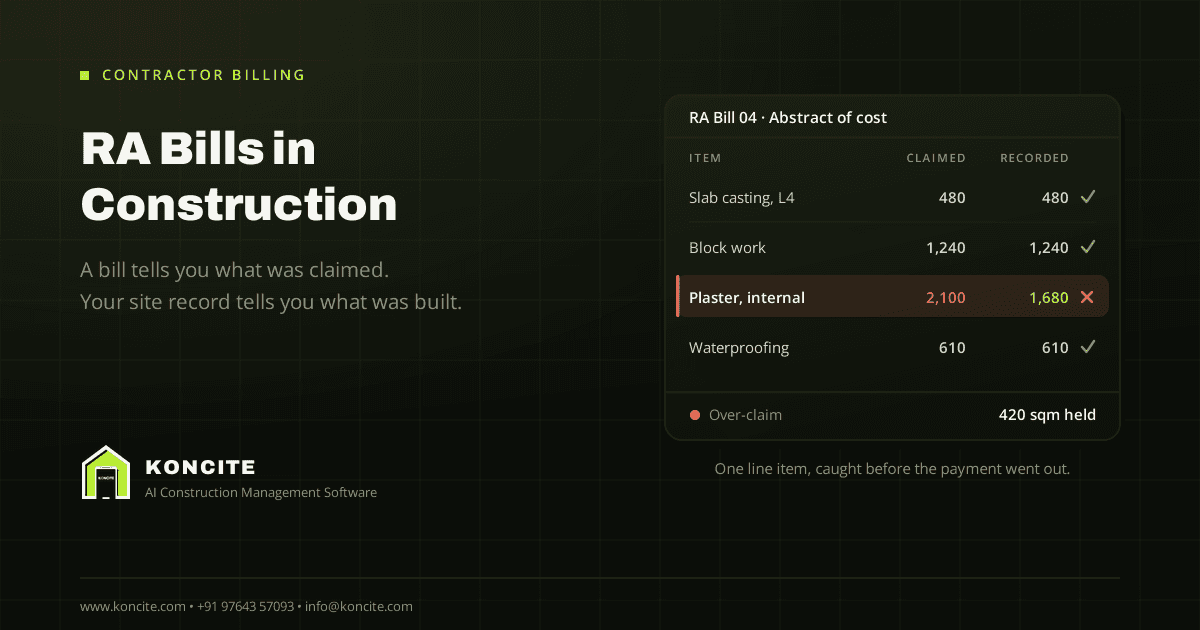
| Abstract of cost | Each BOQ item with quantity up to date, quantity in the previous bill, quantity for this bill, rate and amount |
| Extra and substituted items | Work not in the original BOQ, with the rate basis shown |
| Deductions | Retention or security deposit, recovery of mobilisation and material advances, statutory deductions, recovery for client-supplied material, hire charges, penalties |
| Net payable | Gross value this bill, less deductions, equals amount claimed |
| Certification | Signatures of the contractor, the site engineer who measured, and the authority certifying payment |
If a bill arriving at your desk is missing the quantity in the previous bill column, send it back. Without it there is no way to see what is new this month and what is being carried forward, and that single missing column is how most over-claims survive.
The real problem: a bill gets checked against itself
Here is what happens on most sites when a bill comes in. Somebody verifies that the bill is internally consistent. Quantities times rates equals amounts. Amounts add up to the gross. Deductions are applied. Net payable is correct.
All of that can be perfectly accurate and the bill can still be wrong, because none of it compares the claim to the site.
The question is not “does this bill add up”. The question is “did this work happen, in this quantity, by this date”. Answering that needs an independent record, created at the time the work happened, by someone other than the person claiming payment for it.
On most Indian sites that record either does not exist or exists in a form nobody can use nine months later. Progress sits in a WhatsApp group. Measurements sit in a Measurement Book in a cupboard, or in a joint measurement sheet that was signed in a hurry. Material issue is in a register. Labour attendance is in a notebook. Nothing joins up.
This is exactly the scenario we described in 7 signs your construction site is still running on WhatsApp and Excel, and billing is where it stops being an inconvenience and starts costing money.
The five places RA bills leak money
Across Indian projects, almost every billing leak falls into one of five categories. None of them need fraud to happen. All five happen on well-run sites.
1. Quantity claimed against quantity actually executed
This is the big one, and it is rarely fraud. It is usually optimism plus timing.
A contractor bills for the slab on the 30th because the pour is scheduled for the 29th. The pour slips to the 2nd. The bill still goes in. Nobody deducts it next month, because next month the slab is done and the quantity looks right.
Multiply that across 15 bills and 40 line items and you are consistently paying ahead of execution. You are financing the contractor’s working capital without having agreed to, and if the project stops midway you have paid for work that does not exist.
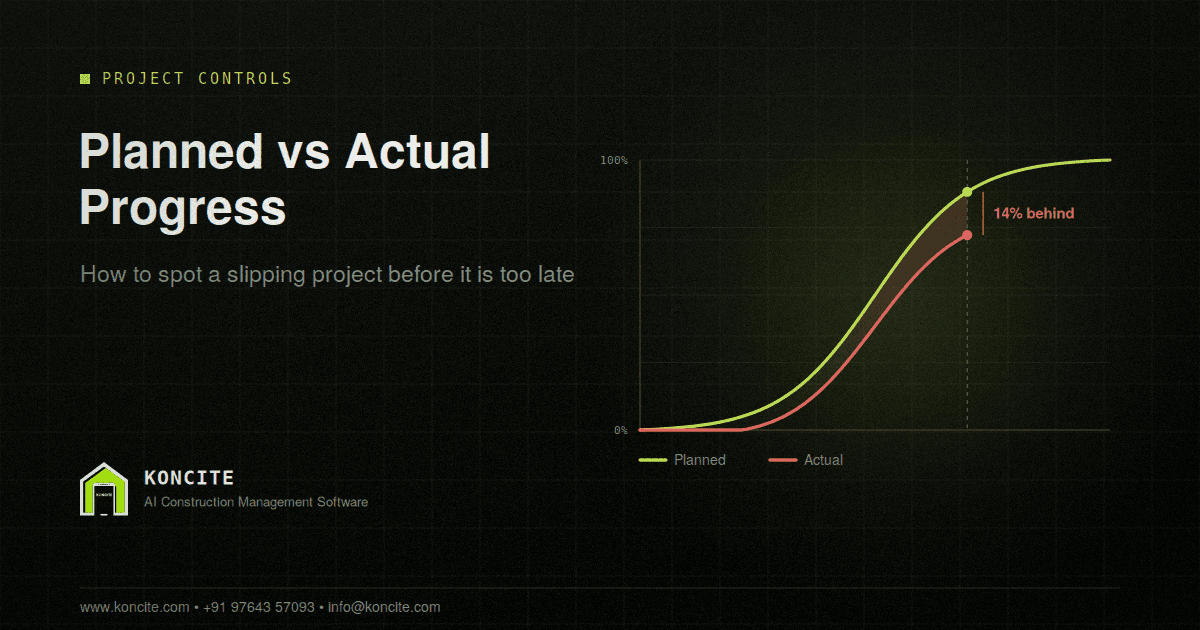
The fix is not suspicion. The fix is having a progress record that was captured on site, on the date, independent of the bill. That is what planned versus actual progress tracking is for. When you can pull up what was recorded as complete on the 30th, the conversation takes two minutes instead of two weeks.
2. Client-supplied material that never gets recovered
On most contracts the client supplies cement, steel and sometimes other major materials. The contract says the contractor is charged for consumption beyond the theoretical requirement.
Almost nobody enforces this, because enforcing it requires knowing two numbers: how much material was issued to the contractor, and how much the executed quantity should theoretically have consumed. The gap is wastage, and under most contracts a part of it is recoverable.
Sites that do not track this are not deducting anything. On a project using a few thousand bags of cement and a few hundred tonnes of steel, the unrecovered wastage is frequently larger than the retention being held. The method for closing this gap is in construction material wastage tracking, and the deduction belongs in the RA bill, not in a conversation at handover.
3. Extra items priced without any rate analysis
Every project has work outside the BOQ. A change in a detail, a site condition nobody anticipated, an addition the client asked for.
What usually happens is that the contractor proposes a rate, the project manager has no basis to argue with it, there is pressure to keep the work moving, and the rate gets accepted. It then becomes the rate for all subsequent quantities of that item.
A rate accepted once under time pressure gets paid 11 more times. The defence is a current market rate reference you can put next to the quoted rate, which is the discipline described in construction material price comparison. You do not need to win the argument. You need to be able to have it with a number in your hand.
4. Labour and day-work claims with no attendance behind them
Day-work claims, idle labour claims and claims for additional manpower deployed at the client’s instruction all get settled through the RA bill, and they are almost always settled on the contractor’s word.
If you cannot produce an attendance record showing how many people from that contractor were on site on the days in question, you cannot contest the claim. You also cannot contest the reverse situation, where a contractor claims he was delayed by you and demands compensation for standing time.
Attendance that lives in a notebook at the site office is not a record for this purpose, because the notebook is not accessible to the person checking the bill and often not accessible at all once the site closes. Construction labour productivity tracking covers how to capture it so that it is usable later.
5. Variation claims from drawing revisions nobody priced
This one catches more builders than the other four combined.
A drawing gets revised. Work had already started to the old revision. Something has to be broken, redone, or built differently. Three months later a variation claim appears in an RA bill, referencing the revision, claiming additional work.
You have no way to establish which revision the site was working to on which date, whether the revised drawing was issued to the contractor before or after he started, or whether he was already working to the latest version and the claim is simply invented.
Drawing revision control is a billing control, not just a technical one. Who received which revision, and when, is the entire basis for accepting or rejecting a variation claim. Construction drawing management covers how to keep that trail, and it is the single most valuable thing you can fix before your next dispute.
A certification checklist you can run in 40 minutes
You do not need a billing department. You need a repeatable sequence. Run this on every bill before it is certified.
Against the previous bill
- Confirm the “paid up to previous bill” figure matches your records, not the contractor’s.
- For every line item, check that the up-to-date quantity minus the previous quantity equals the quantity claimed this period. Errors here are common and always favour the claimant.
- Flag any item where the up-to-date quantity has decreased. That is a correction, and it should be explained.
Against the site record
- Take the five highest-value line items in this bill. For each one, find the date the work was recorded as complete on site. If the bill claims it and your record does not, hold that quantity.
- Check the cumulative quantity against the BOQ quantity. Anything above 100 per cent needs a variation order, not a bill.
- For any item claimed as complete, confirm the quality check or test result exists. Paying for unchecked concrete is paying twice.
Against the contract
- Verify that extra item rates have a written approval, not a verbal one.
- Confirm retention has been deducted at the contract percentage on the gross value of this bill.
- Confirm pro-rata recovery of mobilisation advance and any secured advance on material.
- Confirm applicable statutory deductions have been applied as per the contract and current rules.
- Confirm client-supplied material recovery has been calculated and deducted.
- Confirm any liquidated damages or penalties due under the contract have been applied or formally waived in writing.
Before signing
- The person who measured and the person who certifies should not be the same person.
- The certified copy you keep should carry the quantities you certified, not the quantities claimed, where they differ.
Point 14 matters more than it sounds. If you certify a reduced quantity but keep a copy of the original bill, your own file supports the contractor’s version.
The deduction stack most people get partly wrong
Deductions are where RA bills get sloppy, because they are handled by accounts and the site team never checks them. The usual stack, in order:
- Retention or security deposit, a contract percentage of gross bill value, held until the end of the defect liability period
- Recovery of mobilisation advance, pro-rata against bill value until fully recovered
- Recovery of secured advance on material, as the material is consumed in executed work
- Statutory deductions applicable to the contract, including income tax deduction at source and, where the deductor is covered, GST deduction at source
- Labour cess where the project falls within the scope of the BOCW legislation
- Recovery for client-supplied material beyond permissible consumption
- Hire charges for client plant, machinery, scaffolding or accommodation used by the contractor
- Water and electricity charges as provided in the contract
- Liquidated damages where delay attributable to the contractor has been established
Two things go wrong repeatedly. The first is that retention is deducted on the net rather than the gross, which under-recovers for the whole project. The second is that recoveries for client-supplied material and hire charges are simply never calculated, because the data to calculate them does not exist in a usable form.
Statutory rates and applicability change, and they differ by contract type and by the status of the deductor. Confirm the current position with your accounts team or auditor rather than carrying forward last year’s percentages.
What has to change on site, not in accounts
Everything above is a data problem wearing the costume of a paperwork problem. If you want RA bills you can actually certify, three things have to be true:
Progress has to be recorded daily, by the site team, in a form the billing reviewer can open. Not a WhatsApp photo. A dated record against the activity. This is the entire purpose of a disciplined DPR format for construction, and the DPR is the document that either supports or destroys a billing claim nine months later.
Material issue and consumption have to be on the same system as progress. Issue registers that live separately from progress records cannot produce a consumption comparison, which means the recovery never gets calculated.
Attendance has to be captured contractor-wise, not just headcount-wise. If you cannot say how many of contractor B’s people were on site on the 14th, you cannot settle contractor B’s labour claims.
None of this requires a new process. The site team is already collecting all three. The problem is that it is being collected in WhatsApp groups and notebooks, where the information exists for about a week and then effectively disappears.
Where software helps, and where it does not
Software does not check a bill for you. A person checks the bill. What software does is make the check possible in 40 minutes instead of impossible.
The useful question when evaluating a system is narrow: when a contractor claims a quantity, can I see what the site recorded for that activity on that date, in two clicks, without calling anyone? If the answer is no, the system is a filing cabinet with a login.
This is also the distinction that matters when you are comparing categories of software, which we covered in construction ERP versus construction management software. An accounting-led system will handle the deduction arithmetic correctly and tell you nothing about whether the work happened. A site-led system does the opposite. Billing certification needs both halves to be in the same place.
How Koncite fits
Koncite is an AI-powered construction management platform built for builders, contractors, EPC companies, infrastructure companies and real estate developers. For contractor billing specifically, the point is that the evidence and the claim sit on the same platform:
- Daily progress recorded by the site team against activities, with dates and photographs, so a claimed quantity can be checked against what was recorded when it was recorded
- Labour attendance captured contractor-wise, so manpower and day-work claims have a record behind them
- Inventory and material movement tracked from issue through consumption, so client-supplied material recovery is a calculation rather than a guess
- Contractor billing held against the project rather than in a separate file, so the bill and the evidence for it are in the same place
- AI Drawing Intelligence, which keeps drawings and their revisions under control, so a variation claim arising from a revision can be traced back to the drawing it came from
The teams that get the most out of it are not the ones chasing contractors harder. They are the ones who stopped arguing from memory.
Frequently asked questions
What is the full form of RA bill? RA bill stands for Running Account Bill. It is the periodic interim payment claim a contractor submits during a project for work executed since the previous bill, usually monthly.
How is an RA bill different from a normal invoice? An RA bill is cumulative. It shows total work done up to date, subtracts what was already paid in earlier bills, and claims the difference. A normal invoice covers only the current transaction.
How many RA bills does a project have? It depends on duration and billing cycle. A mid-sized project on monthly billing commonly runs 8 to 15 RA bills before the final bill. Larger EPC and infrastructure contracts run more.
What is the difference between an RA bill and a final bill? An RA bill is an interim claim and remains open to correction in later bills. The final bill closes the running account, settles all remaining quantities, extras and recoveries, and is normally accompanied by a no-claim certificate from the contractor.
Can an over-payment in an earlier RA bill be recovered? Yes. Because the account is running, an excess quantity certified earlier can be corrected by reducing the up-to-date quantity in a later bill. This is why catching errors early matters, and why the up-to-date column should be reviewed every month rather than only the current period column.
Who should certify an RA bill? The person who took the measurements and the person who certifies the payment should be different, and the certification should be against an independent site record rather than against the bill’s own internal arithmetic.
Start with the next bill, not with the project
Do not try to reconstruct the last six bills. That is a dispute, and it needs a different approach.
Start with the next one. Run the 14-point checklist. Pick the five highest-value items and try to find the site record that supports them. Whatever you cannot find is the gap you need to close, and it will tell you more about your project controls than any audit.
If you want to see what that looks like when progress, labour, material and billing sit on one platform, book a demo of Koncite and bring your most recent RA bill. Checking a real bill is a faster way to judge the software than any feature list.